


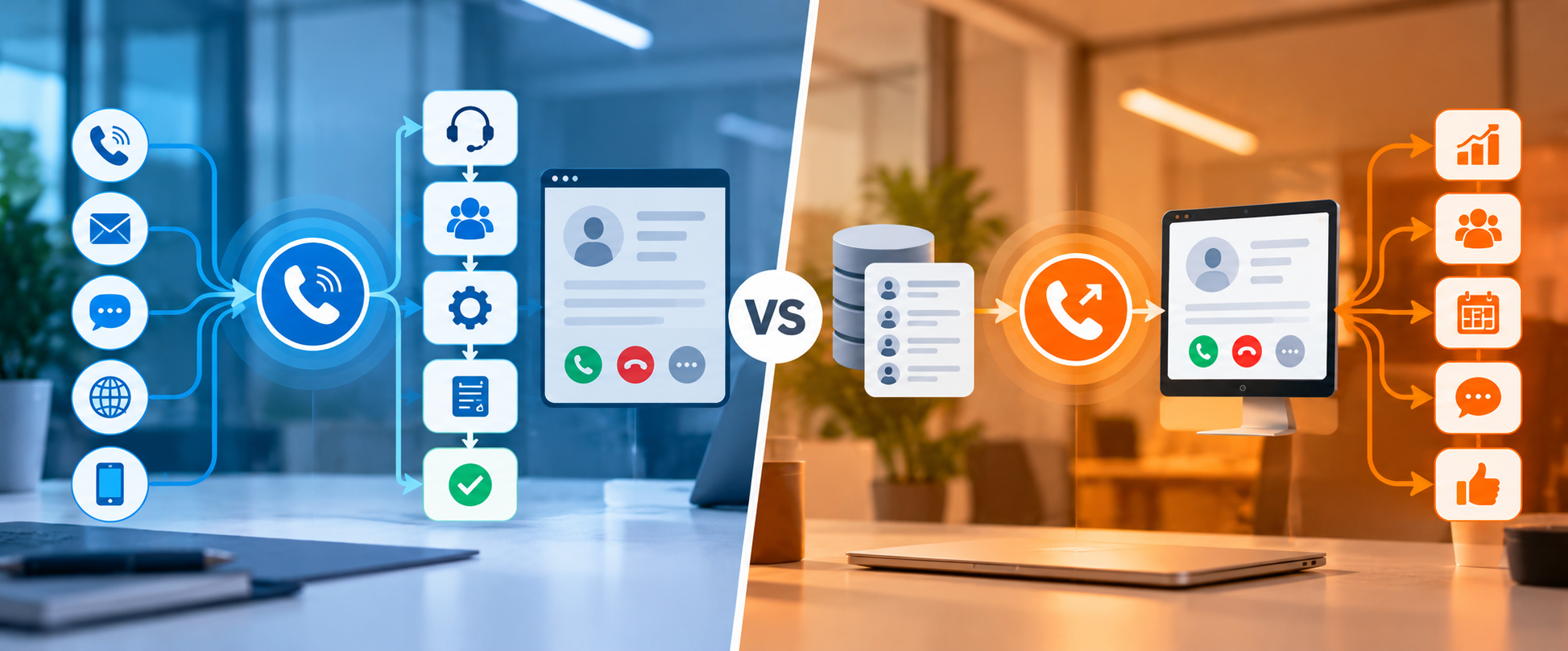
Inbound vs outbound call center processes differ in who starts the conversation, how work is planned, and how success is measured. First, an inbound call center responds to customers who contact the business. In contrast, an outbound call center reaches out to prospects or customers on the business’s behalf. However, both rely on the same basics: trained agents, clear scripts, good data, and consistent quality checks. This guide explains each workflow, compares them side by side, and shows how to choose the right model.
What Is the Difference Between Inbound and Outbound Call Centers?
| Factor | Inbound call center | Outbound call center |
|---|---|---|
| Who starts the contact | The customer | The agent or dialing system |
| Main goal | Resolve issues, answer questions, take orders | Sell, qualify leads, collect, remind, survey |
| Call volume | Driven by customers, so it can spike | Planned by the business, so it is easier to control |
| Pace | Reactive | Proactive |
| Key skills | Listening, problem solving, product knowledge | Persuasion, resilience, objection handling |
| Core technology | Call routing (ACD), IVR, CRM, knowledge base | Dialer, lead lists, CRM, scripts |
| Typical KPIs | Service level, wait time, first call resolution | Contact rate, conversion rate, cost per lead |
| Main risk | Long waits and unresolved issues | Compliance problems and low contact rates |
Therefore, the right choice depends on whether you need to support customers, generate demand, or do both.
What Are Inbound Call Center Processes?
Inbound call center processes cover everything that happens from the moment a customer contacts you until the issue is resolved and recorded. For example, they include answering calls, verifying identity, solving problems, processing orders, and logging outcomes. Moreover, modern inbound teams also handle email, chat, and messaging, so the same process often spans several channels.
Typical inbound call center services include customer service, technical support, order taking, appointment booking, billing questions, and after-hours coverage.
How Does the Inbound Call Center Workflow Work?
- Customer contacts the business. First, the call arrives through a toll-free, local, or dedicated number.
- IVR menu and call routing. Next, an IVR menu offers self-service options or sends the caller to the right team. Meanwhile, automatic call distribution (ACD) routes the call to the best available agent based on skill, language, or priority.
- Greeting and verification. Then, the agent greets the caller and confirms identity where needed.
- Issue identification. After that, the agent asks questions and uses the knowledge base to understand the problem.
- Resolution or escalation. Also, the agent solves the issue, completes the request, or escalates it to a specialist with all details attached.
- Documentation. Once the call ends, the agent records the outcome, notes, and next steps in the CRM or ticketing system.
- Follow-up and feedback. In addition, the system may send a callback, email, or survey.
- Quality review. Finally, supervisors review samples of calls, give coaching, and update scripts.
As a result, a well-designed inbound process answers quickly, solves accurately, and leaves a clear record.
What Are Outbound Call Center Processes?
Outbound call center processes cover how a team plans, runs, and measures campaigns where agents contact people first. For example, campaigns may include lead generation, appointment setting, telemarketing, collections, renewals, order confirmations, and surveys. Moreover, outbound teams depend heavily on data quality, because a poor list wastes agent time and increases compliance risk.
How Does the Outbound Call Center Workflow Work?
- Campaign planning. First, the team sets goals, target audience, offer, call hours, and success measures.
- List building and cleaning. Next, contact lists are collected, checked for accuracy, and removed of duplicates. In addition, numbers on do-not-call lists are scrubbed where the rules require.
- Script and call flow design. Then, the team creates opening lines, qualifying questions, objection responses, and next-step options.
- Dialing mode selection. After that, the team chooses how calls are placed, such as preview, progressive, power, or predictive dialing.
- Connection and qualification. Meanwhile, agents reach prospects, confirm they are speaking with the right person, and ask qualifying questions.
- Conversation and objection handling. Also, agents present the offer, answer concerns, and move toward the agreed outcome.
- Disposition and CRM update. Once the call ends, the agent records the result, such as sale, callback, not interested, or wrong number.
- Follow-up and retries. Next, the system schedules callbacks and retries at suitable times.
- Reporting and optimization. Finally, managers review results, test scripts and lists, and adjust the campaign.
Therefore, outbound success depends on planning, data, and testing as much as on agent skill.
Which Technology Does Each Model Use?
| Technology | Inbound use | Outbound use |
|---|---|---|
| ACD and call routing | Sends calls to the right agent or queue | Less central, but routes returned calls |
| IVR | Offers self-service and menus | Used for callbacks and automated messages |
| Dialer (preview, progressive, power, predictive) | Rarely needed | Core tool for placing calls |
| CRM integration | Shows customer history on screen | Tracks leads, outcomes, and follow-ups |
| Knowledge base | Gives agents consistent answers | Supports product facts and objection replies |
| Call recording and monitoring | Quality and training | Quality, compliance, and training |
| Real-time dashboards | Queue length and wait time | Contact rate and agent activity |
| Do-not-call scrubbing | Not usually required | Essential where rules apply |
| Analytics and reporting | Peak times and common issues | Campaign performance and list quality |
In addition, a predictive dialer can raise outbound volume, but it needs careful tuning to limit abandoned calls. Moreover, some markets cap abandoned-call rates, so check the current rules where you operate.
How Do Agent Skills and Training Differ?
| Area | Inbound agents | Outbound agents |
|---|---|---|
| Core strength | Empathy and problem solving | Persuasion and persistence |
| Product knowledge | Deep, to answer varied questions | Focused on the offer and common objections |
| Tone | Calm, helpful, and reassuring | Confident, friendly, and respectful |
| Training focus | Systems, policies, de-escalation | Scripts, objection handling, compliance |
| Pressure | Handling unpredictable queues | Handling rejection and targets |
Therefore, a strong inbound agent is not automatically a strong outbound agent, so hire and train for the specific role.
How Do Scripts and Call Flows Differ?
Inbound scripts guide agents through greeting, verification, problem solving, and closing. However, they leave room for varied customer questions. In contrast, outbound scripts are more structured, because agents must earn attention quickly. For example, a good outbound opening states who is calling, why, and how long it will take. Moreover, both models should include escalation steps and compliance statements, such as call recording notices where required.
Which KPIs Measure Inbound Call Center Performance?
| KPI | What it shows |
|---|---|
| Service level | Share of calls answered within a target time, such as 80% within 20 seconds |
| Average speed of answer | How long callers wait |
| First call resolution | Issues solved without a repeat contact |
| Average handle time | Average length of a call plus follow-up work |
| Abandonment rate | Callers who hang up before reaching an agent |
| Customer satisfaction | Feedback after the interaction |
| Quality score | Agent performance against standards |
| Occupancy | Share of time agents spend on calls or related work |
Which KPIs Measure Outbound Call Center Performance?
| KPI | What it shows |
|---|---|
| Contact rate | Share of dialed numbers reaching a person |
| Right-party contact rate | Share of calls reaching the intended person |
| Conversion rate | Calls that lead to a sale, booking, or payment |
| Calls per hour | Agent productivity |
| Talk time | Time spent in live conversations |
| Cost per lead or per sale | Campaign efficiency |
| Callback completion | Follow-ups completed on time |
| Compliance rate | Calls that follow required rules and scripts |
| Abandoned call rate | Answered calls with no agent available, when a dialer is used |
Because these call center KPIs measure different things, avoid comparing inbound and outbound teams using the same targets.
How Does Staffing and Forecasting Differ?
Inbound volume depends on customers, so managers forecast it using history, seasons, campaigns, and events. For example, a product launch or billing cycle can create a sudden spike. Therefore, inbound teams use scheduling and flexible capacity to keep wait times low.
Outbound volume, meanwhile, is planned. Managers decide how many numbers to dial and when. As a result, scheduling is easier, but results depend on list quality and call timing, since contact rates vary by time of day and audience.
How Does Quality Assurance Work in Each Model?
- Define standards. First, agree on what a good call looks like.
- Sample calls. Next, review a mix of recordings, including difficult ones.
- Score calls. Then, use a checklist covering accuracy, tone, process, and compliance.
- Coach agents. After that, give specific feedback and examples.
- Calibrate reviewers. Also, make sure supervisors score consistently.
- Update scripts and training. Finally, use findings to improve processes.
In addition, inbound QA often emphasizes resolution and empathy, while outbound QA emphasizes accuracy, honesty, and rule compliance.
What Compliance and Security Rules Apply?
Both models handle personal data, so access controls, secure systems, and staff confidentiality are essential. However, outbound calling usually faces stricter contact rules. For example, many countries regulate consent, calling hours, do-not-call lists, and automated dialing. Meanwhile, inbound teams often handle payment and account details, so they may need to follow card data and privacy standards.
Because rules differ by country and industry, confirm the current requirements with a qualified advisor before launching campaigns.
What Is a Blended Call Center?
A blended call center handles both inbound and outbound work with the same agents and systems. For example, agents make outbound follow-up calls when inbound volume is low, then switch to answering calls when queues grow. Consequently, blended models can improve agent utilization.
| Benefit | Challenge |
|---|---|
| Better use of agent time | Agents need skills for both types of work |
| Faster follow-up on inbound leads | Switching tasks can lower focus |
| More flexible staffing | Requires strong routing and reporting tools |
Therefore, blending works best with clear rules about when agents switch tasks and which calls take priority.
Which Model Should You Choose?
| Your goal | Better fit |
|---|---|
| Support existing customers and resolve issues | Inbound |
| Take orders, bookings, and enquiries | Inbound |
| Generate new leads or appointments | Outbound |
| Collect payments or send reminders | Outbound |
| Run surveys or confirm orders | Outbound |
| Support customers and follow up on leads | Blended |
In practice, many businesses start with inbound support, then add outbound campaigns once service quality is stable.
What Are Common Challenges and Fixes?
Inbound Challenges
| Challenge | Practical fix |
|---|---|
| Long wait times during peaks | Add IVR self-service, flexible staffing, and callback options |
| Low first call resolution | Improve training and the knowledge base |
| Repeat contacts | Fix root causes and improve follow-up |
| Agent burnout | Balance schedules and offer coaching |
Outbound Challenges
| Challenge | Practical fix |
|---|---|
| Low contact rates | Clean lists and test calling times |
| Compliance risk | Scrub numbers, record consent, and monitor scripts |
| Poor conversion | Test scripts and refine targeting |
| Agent turnover | Provide clear targets, coaching, and fair incentives |
What Best Practices Improve Both Models?
- First, define clear goals before you choose tools.
- Second, give agents a CRM view that shows customer history.
- Also, keep scripts updated and easy to use.
- In addition, coach agents with real call examples.
- Moreover, review KPIs weekly and adjust.
- Likewise, protect customer data with strict access controls.
- Finally, collect customer feedback and use it to improve.
Should You Outsource Inbound or Outbound Processes?
| Option | Strengths | Trade-offs |
|---|---|---|
| In-house | Full control and deep brand knowledge | Hiring, training, tools, and management costs |
| Outsourced | Flexible capacity, faster launch, and extended hours | Needs clear briefs, monitoring, and communication |
| Hybrid | Provider handles routine work, while your team handles sensitive cases | Requires clear escalation rules |
When you evaluate a provider, check the following:
- Experience: First, confirm they have run similar inbound or outbound programs.
- Technology: Next, review routing, dialers, CRM integration, and reporting.
- Security and compliance: Also, ask how they protect data and follow calling rules.
- Quality assurance: In addition, confirm how calls are monitored and coached.
- Pricing: Then, request itemized costs and contract terms.
- Reporting: Moreover, agree on metrics, reports, and review meetings.
- Pilot option: Finally, start small before scaling.
What Mistakes Should You Avoid?
- First, do not use one script for every type of call.
- Second, avoid launching outbound campaigns without clean, compliant lists.
- Also, never measure inbound and outbound teams by identical metrics.
- In addition, do not ignore call recordings, because they show what is actually happening.
- Moreover, avoid under-staffing inbound queues during known peaks.
- Likewise, do not skip agent training when processes change.
- Finally, avoid chasing call volume instead of outcomes. As a result, teams may handle more calls but solve fewer problems.
How Can Worldwide Call Centers Help?
Worldwide Call Centers is a global outsourcing consulting firm that connects businesses with call center agencies around the world. Its listed services include inbound and outbound support, telemarketing, lead generation, technical support, and AI-driven solutions. Therefore, if you are comparing providers for inbound, outbound, or blended programs, contact Worldwide Call Centers to discuss your requirements.
Frequently Asked Questions About Inbound vs Outbound Call Center Processes
What is the main difference between inbound and outbound call centers?
An inbound call center answers contacts that customers start, while an outbound call center contacts people first. As a result, inbound focuses on support and service, and outbound focuses on sales, follow-up, and outreach.
Which is harder to manage, inbound or outbound?
Each has different challenges. Inbound is harder to forecast because customers decide when to call. Outbound, however, requires strong data, compliance, and motivation.
What is a blended call center?
It is a call center where agents handle both inbound and outbound work. Consequently, managers can use agent time more flexibly when volumes change.
Which KPIs matter most for inbound call centers?
Service level, average speed of answer, first call resolution, abandonment rate, and customer satisfaction are common priorities.
Which KPIs matter most for outbound call centers?
Contact rate, conversion rate, cost per lead, calls per hour, and compliance rate are common priorities.
Do outbound call centers need a dialer?
Not always, but dialers improve productivity for larger campaigns. However, they must be configured carefully and used within calling rules.
Can a small business run both inbound and outbound calls?
Yes. Therefore, many small businesses start with inbound support and use simple outbound follow-ups, or outsource one side to a provider.
Conclusion
Inbound vs outbound call center processes share many tools, but they differ in goals, workflows, skills, and metrics. First, inbound teams succeed by answering quickly and resolving issues. Next, outbound teams succeed by planning campaigns, using clean data, and following the rules. Therefore, choose the model that matches your goals, measure it with the right KPIs, and consider a blended or outsourced approach when your needs grow.